Scotch Drinkers Only
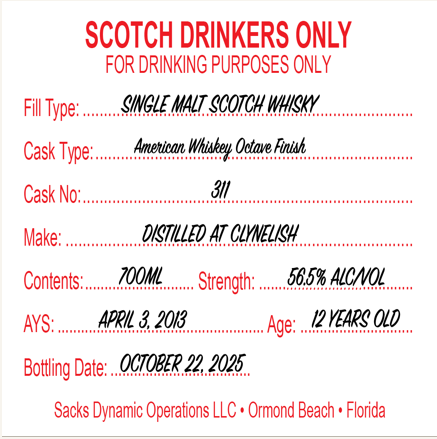
Scotch Drinkers Only - 12 yo Clynelish American Whiskey Octave Finish
Scotch Drinkers Only - 12 yo Clynelish American Whiskey Octave Finish
Scotch Drinkers Only – Clynelish 12 Year Old
Single Cask | Corsair Triple Smoke American Whiskey Octave Finish | Cask Strength
An exceptionally rare single cask Clynelish selected and bottled exclusively for the Scotch Drinkers Only range. Matured for 12 years before a finishing period in a Corsair Triple Smoke American Whiskey Octave, this whisky was bottled at its natural cask strength of 56.5% ABV. The result is a distinctive marriage of Clynelish's celebrated waxy Highland character with subtle layers of sweet smoke, vanilla, toasted oak, and warming spice.
Whisky Details
| Distillery | Clynelish |
| Region | Highlands |
| Brand | Scotch Drinkers Only |
| Age | 12 Years Old |
| Cask Type | Corsair Triple Smoke American Whiskey Octave Finish |
| Cask Number | #311 |
| ABV | 56.5% (Cask Strength) |
| Bottle Size | 700ml |
| Outturn | 57 Bottles |
Tasting Notes
Nose
Fresh orchard fruit, beeswax, vanilla, grilled peach, toasted oak, gentle campfire smoke, and orange zest are layered with hints of cinnamon and honey.
Palate
Rich and beautifully textured with flavors of honeycomb, lemon curd, malt biscuits, vanilla cream, toasted marshmallow, soft wood smoke, cracked pepper, and Clynelish's signature waxy mouthfeel.
Finish
Long and elegant with lingering beeswax, gentle smoke, oak spice, vanilla, citrus peel, and a touch of charred sweetness.
Additional Information
✓ Natural Color
✓ Non-Chill Filtered
✓ Single Cask Bottling
✓ Bottled at Natural Cask Strength
Why We Bottled It
We sourced this Clynelish several years ago and were thrilled to add it to our cask portfolio. Even in its original ex-bourbon cask, it was everything we'd hoped for: elegant, waxy, citrus-driven, and unmistakably Clynelish.
So why change it?
Because one of the things we love most about independent bottling is the freedom to experiment.
Rather than bottling the entire cask as-is, we divided it into three parts. One third remained in the original ex-bourbon cask as a benchmark. One third was transferred into a Corsair Triple Smoke American Whiskey octave, the whisky you're holding today. The final third was re-racked into an Old Sugar Distillery barrel, eventually becoming an exclusive sell-out release for the Exec's Whisky Club out of Orange County, California
Was the original bourbon cask good enough to bottle on its own? Absolutely.
But Howard couldn't resist asking a different question: What happens when one of our favorite Scotch whiskies meets one of our favorite American whiskeys?
The Corsair Triple Smoke octave answered that question beautifully. Rather than masking Clynelish's legendary waxy character, it layered in subtle notes of toasted oak, vanilla, gentle smoke, and spice, creating a whisky that remains unmistakably Clynelish while offering a completely new dimension of flavor.
With an outturn of just 57 bottles, this release represents exactly what Scotch Drinkers Only is all about: respecting great whisky, embracing thoughtful experimentation, and creating bottlings that simply don't exist anywhere else.
About Clynelish Distillery
Clynelish - The Coastal Highland with a Cult Following
The Clynelish Distillery, located in the northern Highlands village of Brora, has as interesting and controversial history. The original Clynelish Distillery was built by the Duke of Sutherland of the opulent Dunrobin Castle estate in 1819 when he realized that whisky production was more profitable than collecting rents from small farmers on his lands. History buffs, likely know what happened next – the crofters were evicted and forced off their lands in what’s today referred to as the Highland clearances.
Also constructed on the duke’s land at this time were mills, tile works, brick works and salt pans, all powered by the coal mines and the crofters and overseen by the duke’s estate manager Patrick Sellar. Profits were king and the people were pushed out of their homes. Some found work in the new industries, while others literally forced out of their homes. It is not a pretty piece of Scottish history but important to understand the geographic disbursement of the Scottish peoples even today.
Clynelish whisky quickly gained popularity and by the end of the 19th century it was one of the most expensive distillates on the market, especially sought after by blenders. Its nicknamed, the “Highland Home of Johnnie Walker” indicating its significance in that blend. The demand for blends continued throughout the 20th century and in 1967, a new Clynelish Distillery was built. The original distillery, renamed Brora, shut down several years later, then re-opened and was eventually shut down and mothballed in 1983, only to be resurrected by Diageo in 2021.
For whisky enthusiasts traveling the NC500, Clynelish Distillery is a must-visit. This scenic coastal route from Inverness winds through cliffs and passes castles, leading to the northernmost tip of mainland Scotland, where you can catch a ferry to Orkney. Along the NC500, you'll find distilleries like Balblair and Glenmorangie, which have been crafting whiskies for centuries. Further north lies Brora, home to both Clynelish and Brora Distilleries.
The Clynelish Distillery, located in the northern Highlands village of Brora, has as interesting and controversial history. The original Clynelish Distillery was built by the Duke of Sutherland of the opulent Dunrobin Castle estate in 1819 when he realized that whisky production was more profitable than collecting rents from small farmers on his lands. History buffs, likely know what happened next – the crofters were evicted and forced off their lands in what’s today referred to as the Highland clearances.
Also constructed on the duke’s land at this time were mills, tile works, brick works and salt pans, all powered by the coal mines and the crofters and overseen by the duke’s estate manager Patrick Sellar. Profits were king and the people were pushed out of their homes. Some found work in the new industries, while others literally forced out of their homes. It is not a pretty piece of Scottish history but important to understand the geographic disbursement of the Scottish peoples even today.
Clynelish whisky quickly gained popularity and by the end of the 19th century it was one of the most expensive distillates on the market, especially sought after by blenders. Its nicknamed, the “Highland Home of Johnnie Walker” indicating its significance in that blend. The demand for blends continued throughout the 20th century and in 1967, a new Clynelish Distillery was built. The original distillery, renamed Brora, shut down several years later, then re-opened and was eventually shut down and mothballed in 1983, only to be resurrected by Diageo in 2021.
For whisky enthusiasts traveling the NC500, Clynelish Distillery is a must-visit. This scenic coastal route from Inverness winds through cliffs and passes castles, leading to the northernmost tip of mainland Scotland, where you can catch a ferry to Orkney. Along the NC500, you'll find distilleries like Balblair and Glenmorangie, which have been crafting whiskies for centuries. Further north lies Brora, home to both Clynelish and Brora Distilleries.
In typical Diageo fashion, the Clynelish visitor experience caters to both whisky novices eager to learn about Scotch and connoisseurs looking to taste specialty and limited expressions. The site features a coffee shop to warm up after a chilly day and a gift shop offering a wide array of bottles and exclusives. You might also spot the elusive Clynelish cat, a Scottish wildcat, around the premises. Today, Clynelish is still used in Diageo’s blended malts, but its single malts, whether official releases or independent bottlings, remain highly prized.
Share